
Marine electricity must today address a paradox: boats are carrying ever more electrical and electronic equipment, while operating in an environment considered aggressive. For shipyards and boaters alike, the reliability of an electrical installation therefore depends not only on the quality of the components, but also on the overall system design, wiring, protections, and the anticipation of future uses in this humid and salty atmosphere. Here is an analysis.
Why is marine electricity subject to extreme conditions?
A modern car carries a considerable amount of electronics, which does not prevent it from traveling at high speeds in the rain, in the cold, or on a salt-laden road, all while maintaining a high level of safety. The reason for this reliability? It is based on systems designed to withstand their use regardless of the conditions or the age of the vehicle.
On a boat, the challenge is comparable. Indeed, salt humidity, spray, condensation, temperature fluctuations, and vibrations continually stress the equipment. And, unlike cars, this is sometimes compounded by successive modifications, carried out over the years without a true overall vision. In this context, the reliability of electricity on board a vessel depends as much on the initial design as on the attention paid to the technical details of the installation (both at the origin and throughout the life of the boat).
Boat electrical installation: key points of vigilance
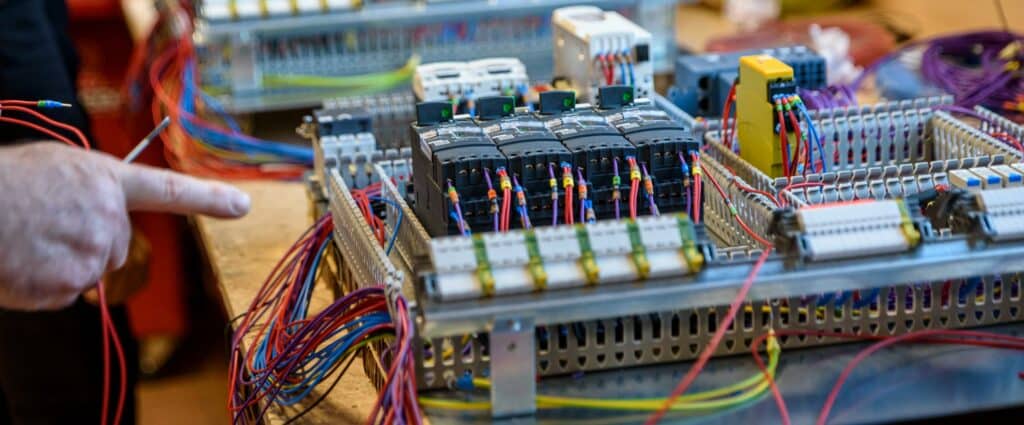
On board a vessel, a reliable electrical installation rests first on the quality of its connections. The lugs must be correctly crimped, protected, and adapted to the marine environment, while the conduits, wires, and other electrical cables must be properly protected and inspected; the objective is to identify any wear, cuts, or signs of overheating.
Furthermore, the sizing of conductors, the presence of fuses, circuit breakers, or electronic protections adapted to each circuit prove essential. It is also advisable to monitor for potential current leakage (particularly for boats with conductive hulls: steel, aluminum, and carbon) and to verify the grounding for alternating current.
Corrosion, humidity, and vibrations: often invisible degradation
The enemies of marine electricity generally work in the shadows. A slightly oxidized connection can thus continue to function while offering increasing resistance to the flow of current; it then heats up further and progressively becomes unstable, increasing the fire risk due to excessive overheating.
For their part, vibrations can loosen a connection, weaken a conductor, or alter a joint. These defects can be difficult to diagnose, precisely because they may not lead to a clean failure.
Why some boat electrical installations age better
The most durable installations are not necessarily the most complex. Their strength lies in a clear architecture, correctly sized circuits, adapted components, and carefully labeled wiring. Another crucial point is that up-to-date plans facilitate maintenance while avoiding improvised connections and allowing the boat’s electrical installation to evolve without disrupting the existing system. Hence the importance, for those performing the work, of providing plans of the modifications carried out and adding them to the initial file.
Electricity on a pleasure boat: the decisive role of engineering
In the field of marine electricity, engineering proves decisive since it allows for the anticipation of consumption, the prioritization of essential functions, the planning for future developments, and the simplification of diagnostics. It also contributes to designing systems that are more legible and easier to maintain, while guaranteeing greater daily safety.
Koriolan thus supports French shipyards located on the Atlantic (La Rochelle, Lorient, Concarneau, Saint-Nazaire…), in the Mediterranean (La Grande-Motte, Marseille, La Ciotat, Toulon, Hyères, Cannes…), and in the English Channel (Cherbourg, Saint Malo, Caen…), as well as their European counterparts, from the Baltic to the Black Sea. Its expertise covers the study of electrical architecture, the creation of plans, and the integration of solutions adapted to the real needs on board.
Want to know more? Contact us!
 By Séverine Korovic