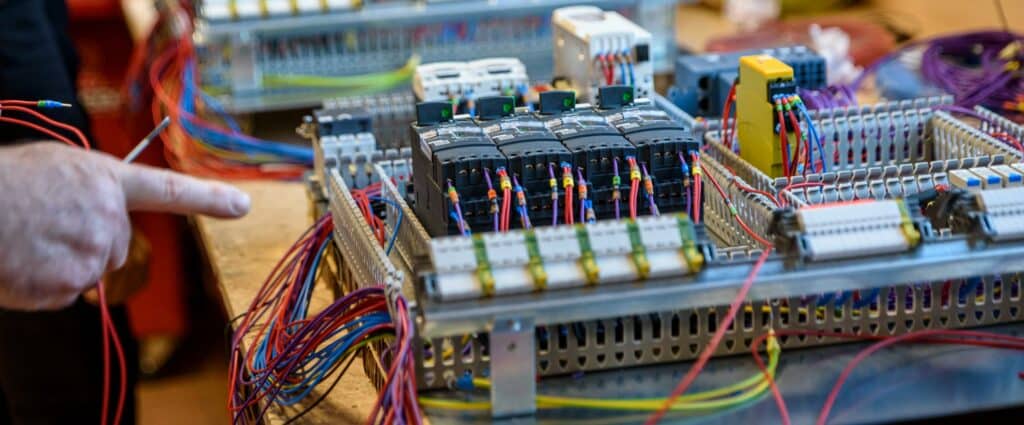

The electrical refit of a boat is one of the critical projects in the life of a vessel. On a 14-meter unit, the price of a refit can be comparable to that of a new teak deck, between €30,000 and €45,000. Yet when it comes to modernizing the electrical installation onboard, owners often hesitate more. And for good reason: while a deck is immediately visible on a boat, a reliable, secure and scalable electrical installation works behind the scenes. Nevertheless, its importance is just as strategic for the safety, comfort, autonomy and value of the vessel. Let’s take stock.
Why consider an electrical refit on a boat?
A marine electrical refit represents a financial investment. But while it is important to be able to move around a deck safely, it is equally essential to have a reliable electrical network (electrical wiring, electrical panel) that is properly designed to protect both the crew and the boat.
Furthermore, onboard equipment has evolved considerably in recent years. The emergence of lithium batteries, the installation of solar panels, MPPT regulators and other smart alternators now open up new possibilities for energy autonomy on a boat.
Boaters are also seeking greater comfort and peace of mind. These expectations are made possible through features such as:
- detailed visualization of onboard equipment consumption,
- receiving alerts in case of anomalies,
- automation of certain processes,
- centralized management provided by a digital dashboard.
All these systems help reduce the mental load onboard for the skipper, and require a redesign of the electrical architecture.
Finally, the current capabilities of equipment make it easy to envision very good autonomy, in both direct current and alternating current. Today, equipping for 230V consumption is no longer unreasonable onboard; it is even becoming a standard without requiring a generator or expensive equipment.
The most common mistakes during a boat electrical refit
One of the most common mistakes is to replace certain equipment without reviewing the overall architecture of the electrical installation onboard the boat. A high-performance lithium battery or a modern inverter cannot compensate for aging wiring or a design that has become unsuitable. Worse, it even poses serious risks.
Another frequently encountered situation: the accumulation of modifications made over the years. Adding equipment, relocating a circuit, integrating a new device… These successive changes sometimes end up making the installation difficult to understand, maintain and evolve. Or even become dangerous!
Finally, the absence of an up-to-date electrical diagram constitutes a real handicap during maintenance, diagnostic or resale of the boat operations.
Does an electrical refit for a boat necessarily cost a lot?
Like any naval modernization project, the cost of a boat refit depends on the desired level of intervention. A partial upgrade will obviously not require the same budget as a complete overhaul of the installation.
However, the marine electrical refit should be considered an investment rather than a simple expense. A modern installation considerably extends the vessel’s lifespan while providing greater comfort, autonomy and safety. It also facilitates future maintenance and upgrade operations, while helping to preserve the vessel’s value.
Ultimately, the cost of an ill-suited or unreliable installation can prove far higher than that of a properly designed refit.
Whether it involves modernizing an existing boat, integrating new equipment or designing a complete electrical installation for a new build, Koriolan’s teams support owners, shipyards and nautical professionals throughout France and Europe.
 By Séverine Korovic