

Electronics on board pleasure boats now occupy a considerable place. Gone are the sextants, bulky ephemeris tables, and bearing compasses… These traditional tools have progressively given way to GPS, multifunction displays, and other electronic navigation aids. While this evolution contributes to comfort and safety, installing these devices must follow very precise rules to avoid any malfunction. What rules must be followed to ensure the reliability of the installation? Here’s an explanation.
Marine electronics: how do NMEA networks work?
On a pleasure boat, including units under 24 meters, several electronic networks can coexist. Their role? To allow navigation devices, whether a marine GPS, a depth sounder, an autopilot, or a multifunction display, to exchange information.
NMEA 0183: a pioneer of marine communication
Published in 1983, NMEA 0183 is one of the first standardized networks allowing marine electronic equipment to communicate with one another. Developed by the National Marine Electronics Association, it defines a common language for transmitting data between devices, including those from different brands. Gradually replaced by its successor, NMEA 2000, NMEA 0183 nevertheless remains present on older boats.
NMEA 2000, a new generation of electronic network
Introduced in 2000, NMEA 2000 is built around a backbone, in other words a main cable running through the boat, to which equipment is connected via T-connectors. Inertial measurement units, wind instruments, and multifunction displays can thus share their data on the same network.
Compared to NMEA 0183, this architecture makes it easier to install and add equipment. It also allows for faster data exchange and better interoperability between compatible devices.
J1939 and Ethernet: two other essential onboard networks
J1939: the electronic network dedicated to the boat’s propulsion system
The J1939 network manages all communications for the engine(s) and certain associated systems. It notably transmits engine speed (RPM), temperature, oil pressure, fuel consumption, and alarms.
Depending on the architecture, it can also activate engine commands related to acceleration, the gearbox, starting, or shutting down.
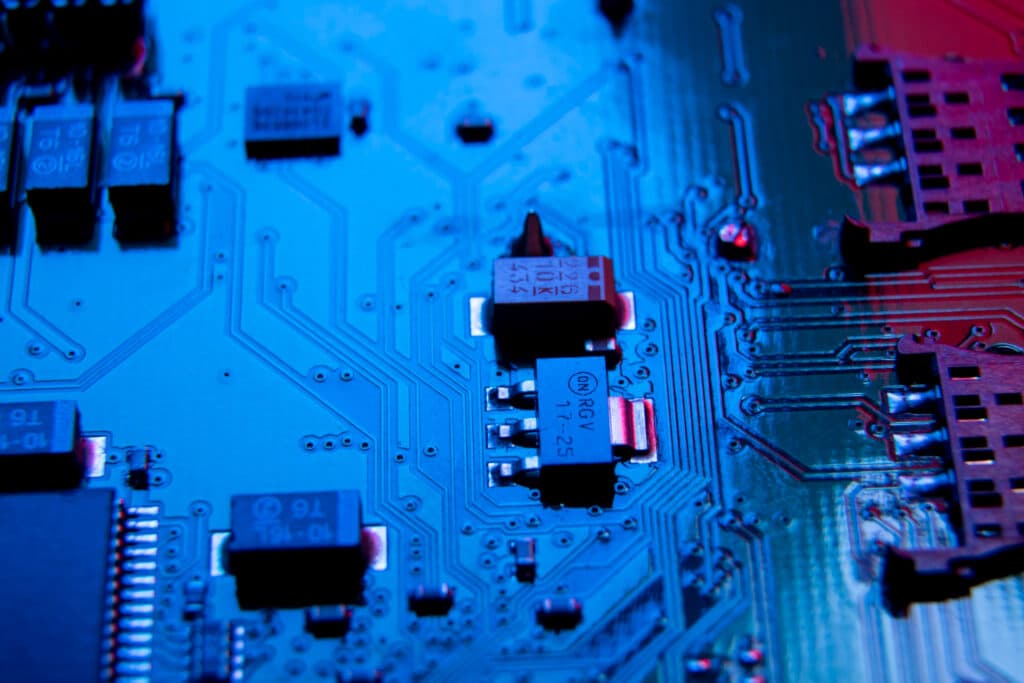
Ethernet: the onboard computer network
Well known in the computing world, at home or at work, Ethernet is also used on board boats. Unlike NMEA 2000, which is suited to transmitting navigation and sensor data, this network can carry large volumes of information, particularly radar images or sounder data. When connected to the internet, it can also help receive weather information or update equipment.
SeaTalk, RayNet, and S-Link: manufacturer-specific networks
In addition to the four main families mentioned above, some manufacturers develop their own marine electronic communication systems.
SeaTalk: Raymarine’s electronic network
Developed by Raymarine, SeaTalk allows the manufacturer’s navigation instruments to communicate, either alongside the main network or, depending on the network generation, in conjunction with NMEA 2000 (via conversion cables).
RayNet: Raymarine’s high-speed network
RayNet is Raymarine’s high-speed Ethernet network, mainly used for transmitting radar and camera data.
S-Link: Sleipner’s network
Developed by Sleipner, S-Link is a communication and control network dedicated to the bow thruster manufacturer’s equipment. Its purpose is to centralize and synchronize the management of maneuvering equipment.
Marine electronics installation: what rules prevent failures?
These networks prove reliable, provided their installation and interconnection rules are scrupulously followed. NMEA 2000 is an excellent illustration of this. For example, the maximum length between the backbone and a connected device must not exceed 6 meters. The network must also include appropriate electronic terminations, or risk major malfunction.
As a result, a non-compliant installation can cause serious failures, potentially compromising the safety of the crew and the boat. Even trickier, intermittent failures can appear and disappear without an immediately identifiable cause. They considerably complicate diagnosis and can keep technical teams occupied for many hours.
This is why it is in the interest of shipyards and installers to design a coherent electronic architecture from the outset, anticipate interconnections, and verify that the networks function properly before the vessel is delivered.
Your marine electronics installation project with Koriolan
Are you preparing the initial fit-out of a boat or an electrical and electronic refit? Based in Sainte-Foy-lès-Lyon, near Lyon, the Koriolan engineering firm supports shipyards in the Mediterranean, along the Atlantic coast, in the Channel, and more broadly across Europe.
From the study of the onboard architecture to the production of diagrams, through to cabling, equipment integration, functional testing, and sea trials, our teams bring you their dual expertise in marine electrical and electronic systems.
Entrust your marine electrical design and installation project to Koriolan!

 By Séverine Korovic
No comment yet, add your voice below!