

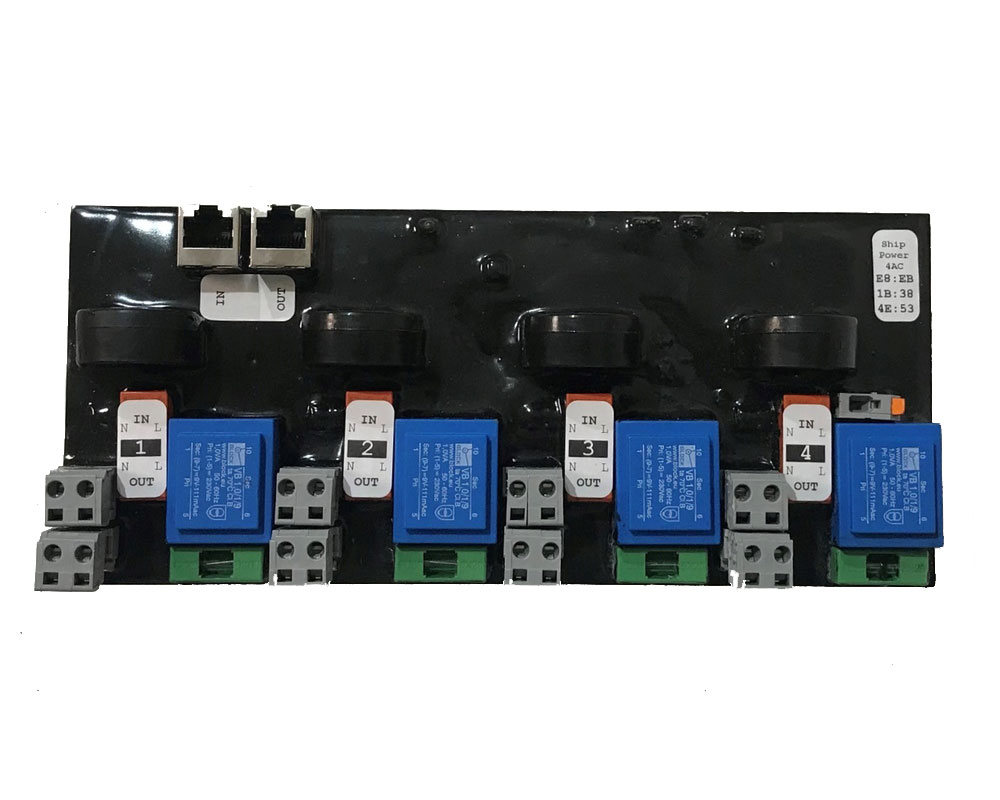
ShipPower4AC Module: Controls 4 AC Circuits

An integral part of the ShipHeart™ digital switching solution, the ShipBS module monitors a 12, 24, or 48V battery bank. It measures continuous currents up to ± 380A and accepts overloads (e.g., starting current) up to nearly 2000A.
Get the technical documentation for the marine battery monitoring module
The ShipBS module installation is quick and easy, even in confined spaces on board.
The ShipBS module is installed on the negative terminal of the boat’s battery bank. Its integrated braid allows it to be
A measuring cable is supplied with each ShipBS. Fully pre-wired, it is connected to the module by a
Good to know: the connection cable to use is a commercial Ethernet Category 6 or higher cable. It can also be custom-made to precisely fit the required length.
The module can be inserted anywhere on the bus, regardless of the type of module located upstream (towards ShipBase) or downstream.
However, its position on the bus distinguishes this boat battery monitoring module from other modules. It is thus recognized by ShipBase upon connection, which, if its version is not up to date, updates it immediately and automatically. Like all modules of the ShipHeart™ digital switching system.
The only constraint: the cable from the upstream module must be connected to its In connector. And, if it is not the last module, the cable intended for the downstream module must be connected to its Out connector.
If it is the last module, its Out connector is unused. It is then advisable to leave the rubber cap supplied with the module in place to protect it from dust and moisture ingress that could impair the subsequent connection of additional modules.
Good to know: given its structure and the high speed of exchanges, the bus is equipped with termination resistors. However, these are automatically adjusted by ShipBase with each addition or removal of a module.
The ShipBS module continuously measures the battery terminal voltage, its internal temperature and, of course, its differential current.
These data can then be processed by ShipBase, which also has the precise consumption of the on-board equipment powered by this marine battery bank.
This processing, partly patented by Koriolan, allows for detailed information on the battery bank status to be communicated:
This information offers the boater a complete overview of the status and energy autonomy of their boat.
The ShipBS module is therefore quite similar to a classic shunt, but it is the data available within the ShipBase boat dashboard that allows for the provision of unprecedented information, without additional sensors (and thus without associated wiring…):